 Russia
 Belarus
 Georgia
 Kazakhstan
 Kyrgyzstan
 Uzbekistan
 China
China Nepal
Nepal Bangladesh
 Poland
 Romania
 Slovakia
 Hungary
 N. Macedonia
 Vietnam
 Canada
 Armenia
 UK
UK Australia
 USA
USA Ireland
 Germany
 New Zealand
 Italy
Italy France
 Singapore
 Netherlands
 Sweden
 Switzerland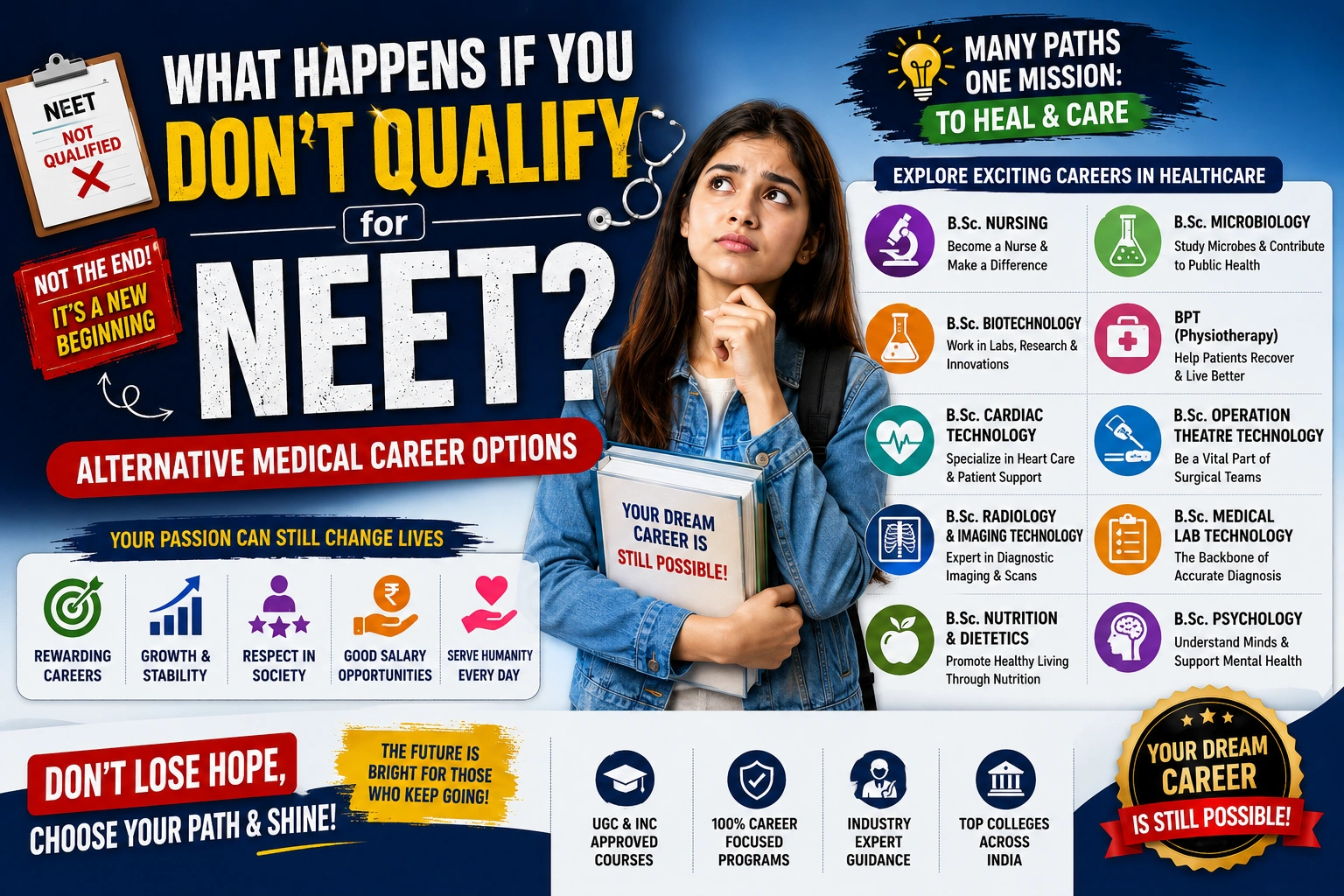
In India, the National Eligibility cum Entrance Test (NEET) is a critical step for aspiring doctors. NEET sees a participation of several lakhs each year, and due to limited seats, many applicants do not qualify. Not qualifying NEET is understandably a setback, but it does not close the option of working within the healthcare system.
There are many alternative pathways within the medical field that offer ample opportunity to engage with healthcare, research and technology, and patient care. Individuals that do not qualify NEET should consider their options.
Choosing an alternative pathway should be done with an understanding that the healthcare system is a myriad of sectors with opportunities beyond becoming an MBBS.
NEET and Its Role in Indian Medical Education
The NEET examination is the primary way to gain admission into MBBS, BDS, and other medical programs in India. NEET is taken by students that wish to gain admission into medical schools that are recognized and sanctioned by the governing bodies such as the National Medical Commission (NMC).
For students that wish to pursue their medical studies abroad, qualifying NEET is a requirement of the medical education regulations in India. Students that wish to take advantage of the opportunities that international medical education has to offer may visit the MBBS Advisor ,MBBS Abroad section to learn about the options available to them.
Not qualifying NEET does not hinder students from pursuing a career in healthcare. There is a wide range of allied and advanced healthcare professions that offer lucrative career opportunities and the ability to make an impact on the community.
What Are the Options if You Cannot Qualify NEET?
Qualifying for NEET is an important step in becoming a doctor. The absence of this qualification may cause students to feel anxious and uncertain. However, students should know that their career is not determined by one exam.
Students can make a multitude of decisions including preparing for the exam again, pursuing an undergraduate degree in healthcare, applying for eligible positions in international healthcare, and choosing careers related to the advancement of healthcare technology and research.
Many professionals that work in healthcare biotechnology, pharmacy, nursing, management, research, and medical technology careers are successful and have not studied to become an MBBS physician.
The best option is determined by what students are interested in pursuing.
What Are the Options in Healthcare After Failing to Qualify NEET?
Bachelors of Pharmacy (B.Pharm)
Pharmacy is another common avenue for students wishing to study in allied healthcare. A Bachelors of Pharmacy degree focuses on research in the development of medicines and healthcare in the provision of drug related therapies.
Pharmacists are valuable professionals in allied healthcare because they are experts in medicine. After their Bachelors of Pharmacy degree, students are able to work in the pharmaceutical industry, healthcare, medical research, and regulatory affairs.
The pharmaceutical industry offers a multitude of options as it continues to expand and improve drug development and related clinical research.
Bachelor of Science (B.Sc) in Nursing
Nursing is a highly regarded profession within the healthcare system.
B.Sc Nursing students are educated on the management of patients and the proper method of executing and managing healthcare activities. Nurses work alongside physicians in order to provide supportive treatment and assist in the achievement of better outcomes for patients.
With healthcare personnel in high demand around the world, nursing presents excellent employment opportunities, both domestically and internationally.
Biotechnology and Biomedical Science
Students with an interest in research, the sciences, and healthcare innovations may opt to pursue studies in biotechnology and biomedical sciences.
This area of study is focused on the sciences, particularly the advancements in healthcare and treatment of illnesses, research on health related technologies, and the development of vaccines.
Biotechnology uses sciences and technology to improve health and develop medicines and research.
Bachelor of Physiotherapy (BPT)
This is also a thriving profession for students interested in rehabilitation and recovery of the patient.
Physiotherapy is focused on the recovery and rehabilitation of patients who have sustained injuries or have a physical disability.
There is an increasing demand for physiotherapists as awareness of physical health, sport related injuries and the need for rehabilitation care grows.
Bachelor of Medical Laboratory Technology (BMLT)
Laboratory Services are a cornerstone of healthcare.
BMLT programs provide an education on laboratory services, diagnostic pathology, and microbiology. Physicians require laboratory services to assist with the diagnosis and formulation of treatment for patients.
There are many opportunities for graduates of this discipline to work in healthcare.
Psychology and Mental Health Careers
There has been a greater focus on mental health and illness in society and a greater need for qualified psychologists and mental health practitioners.
Psychology courses deal with human behavior, feelings, and mental health, and offer a wide range of career opportunities. Careers in psychology can be pursued in hospitals, mental health counseling centers, schools, and health and wellness centers.
Healthcare Management and Administration
As discussed above, health care can be a clinical service offered to patients. Hospitals and other health care institutions need people to manage the operations, administration, finance, and the service to patients.
Students can pursue healthcare management programs to build a career in the administration of hospitals, health care consulting, and management of medical services.
This is a dynamic field that blends the knowledge of health care and management; thus, it offers a good career growth opportunity.
Medical Courses Abroad Outside of MBBS
Some students may seek alternative international education when their score falls below their expectations on the NEET. While there are opportunities to study medicine abroad, students must consider their eligibility and restrictions.
Students must check course outlines, the recognition of the universities, and the regulatory frameworks before opting for any foreign medical course. Information on recognized medical schools can be found on the World Directory of Medical Schools (WDOMS).
Medical students planning to study abroad need to understand NEET, Recognition, and Licensing requirements.
Should You Try NEET Again?
It is common for students to take the NEET again if they did not achieve their desired score. It is reasonable to do so if the student is willing, has a good plan for improvement, and is committed to the MBBS.
Students must examine their past performance and identify weaknesses and develop more effective study techniques and realistic study schedules.
Students can also consider options such as using the NEET Rank Predictor tool to estimate their potential rank and aid in making more informed career decisions.
A second attempt brings another chance to achieve the life goal of becoming a doctor, but students should maintain other career options as well.
NEET Related Career Planning
After deciding to pursue a career post-NEET, researching and evaluating options should be the primary focus. Consideration of personal interests, skill sets, available finances, and probabilities of future employment is essential when choosing a career.
Healthcare is a broad industry and every single career option leads to the potential to improve the quality of life for individuals. One career in healthcare should not be limited to one becoming an MBBS doctor. Countless opportunities exist in every one of the healthcare professions to positively influence people and provide critical services.
One of the most important factors in making a choice is to avoid choosing one based only on societal pressures. The most important career choice is one that aligns your interests with your goals.
MBBS Advisor
Medical education involves many pathways and choosing among them can be quite challenging for students. The MBBS Advisor can assist you with many of the medical pathways and guides available and education and career options.
Although students may be seeking many different options ranging from NEET preparation to medical degrees abroad to other careers in healthcare, having enough guidance can aid them in making the best decisions.
Furthermore, students may find lots of specialized resources available on NEET, various admission options, and on medical education for greater knowledge of the many opportunities available.
Final Thought
Not passing NEET might be hard for students, and it can seem like it is the end of the line when thinking about a career in healthcare, but this is not true. There are many career paths that one can take in the healthcare field besides an MBBS, like pharmacy, nursing, biotechnology, physiotherapy, healthcare management, and laboratory technology.
After not qualifying for NEET, students take that opportunity to see what career options are available and choose a career based on your interests. The healthcare industry has a lucrative future and can be fulfilling and successful if one is willing to dedicate and plan their time toward that goal.
Students can also refer to the World Health Organization (WHO) for global healthcare information and medical awareness. No student has a single exam that determines their future career. The healthcare field has many roles and job opportunities, and with the wide variety of career options and roles, one can improve healthcare services all over the world.