 Russia
 Belarus
 Georgia
 Kazakhstan
 Kyrgyzstan
 Uzbekistan
 China
China Nepal
Nepal Bangladesh
 Poland
 Romania
 Slovakia
 Hungary
 N. Macedonia
 Vietnam
 Canada
 Armenia
 UK
UK Australia
 USA
USA Ireland
 Germany
 New Zealand
 Italy
Italy France
 Singapore
 Netherlands
 Sweden
 Switzerland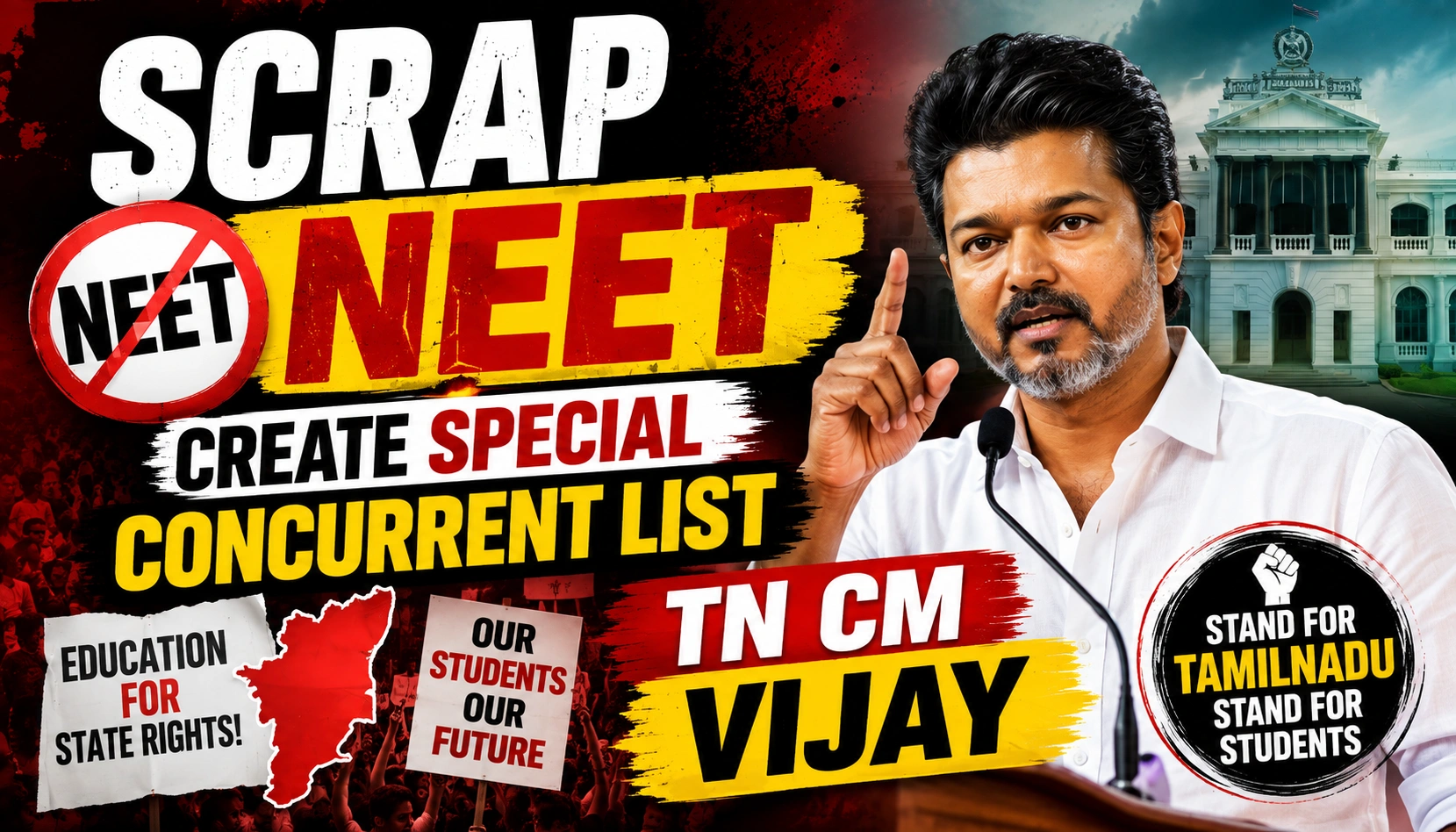
The NEET controversy returned when Tamil Nadu CM Vijay criticized the examination system calling for the removal of NEET in its current form. In his demand, he added that a special concurrent list be created for NEET for both the Central and State Governments to share the responsibility for policy-making concerning medical admissions.
For Medical aspirants looking for guidance for preparation, updates and admissions in medical colleges, MBBS Advisor is the place. It covers the latest updates on NEET and MBBS admissions in India and abroad.
Why Did Tamil Nadu CM Vijay Raise the NEET Issue?
Since its implementation, NEET has created many controversies across states, especially Tamil Nadu. CM Vijay has repeatedly stated that the examination is arbitrary and unfair for students from different educational boards. He has expressed concern for students studying in different states.
According to the Tamil Nadu government, disadvantaged students from rural areas and from government schools will find it harder to compete with students from better coaching schools. The demand to place NEET on the special concurrent list is to allow the state more responsibility for framing policies of medical admissions.
This has become a major political and educational issue as medical education has a bearing on the availability of healthcare and especially in states where government medical colleges cater to a large segment of the population.
Understanding the Demand for a Special Concurrent List
In India, the Constitution has made three categories of subjects:
- Union List
- State List
- Concurrent List
The Concurrent List contains subjects on which both the Central and State Governments can have laws. Tamil Nadu’s demand is for such a special category to be created so that NEET can involve both levels of Government.
Those who support this demand believe that the State Governments can better appreciate the implication of education at the grassroots level and should, therefore, have a greater say in formulating admissions.
Those who defend NEET say that uniformity in the exam system helps to maintain a uniform standard in the system. A national level test helps students to be evaluated on a common plane, instead of being assessed in various criteria, state level, etc.
NEET and Medical Admission Policies
The Medical Counseling Committee (MCC) introduced NEET to bring about a uniform test for admission to MBBS, BDS, and other medical courses. There were multiple state-level as well as private medical entrance tests before NEET. Different exams meant multiple applications for students.
The National Medical Commission (NMC) sets the standards for medical education and has published guidelines. The NMC guides students on the official medical education guidelines.
The basic concepts behind NEET are:
- og transparent admission
- Every candidate gets a fair chance through a single entrance exam
- Unified standards of eligibility
Many feel there is a need for reforms in the exam system to address the problems of affordability, regional disadvantage, and market-driven coaching.
Tamil Nadu’s Continuous Opposition to NEET
Tamil Nadu is among the most vehement of the NEET opponents. The state claims that admitted students earlier were based on class 12 marks which meant students who were consistent performers were rewarded.
The state has also claimed that students from economically disadvantaged groups would find it difficult to compete as a majority of NEET aspirants rely on expensive coaching.
Other leaders from the state have also demanded that NEET be repealed to allow medical admission policies that are more flexible and consider state-based education systems.
Impact of NEET on Medical Aspirants
There is no doubt NEET has altered the medical admissions process in the country. Thousands of aspirants enroll for NEET each year. This number is expected to increase in the coming years.
NEET requires a great deal of planning, preparation and consistent efforts. Aspirants will also have to consult NEET preparation guides like that of MBBS Advisor that contain a wealth of information about the examination, the eligibility norms and the preparation process.
The major impact of NEET has been on:
- Tougher competition among medical aspirants
- Importance of national ranking
- Need for organized preparation and discipline
- Competitive exam skills
Some aspirants also utilize the NEET Rank Predictor by MBBS Advisor.
Pro NEET Opinions
NEET proponents argue that before the implementation of NEET, students appeared for a variety of examinations that led to financial burden coupled with additional academic pressure. NEET consolidated these examinations and eased the process of admissions.
NEET ensures that medical professionals maintain the same standard across the country. Several organizations that deal with medical education abroad and international medical programs support MBBS Abroad.
Concerns About NEET
Opponents of NEET think a single exam cannot assess all students’ abilities. Students from various boards learn different syllabi and follow different pedagogies.
Major concerns include:
- Coaching institution dependence
- High financial burden on students
- Issue for rural students
- Mental stress due to extreme competition for ranks
- Ignoring intra-school level performance
NEET’s critics think medical admission should focus on providing opportunities to deserving students instead of evaluating the performance in a single exam.
Position of WHO and WDOMS in Medical Education
Boundaries do not exist for medical education. Healthcare educational standards are set by various global organizations.
The World Health Organization (WHO) works towards betterment of health care systems across the globe and the World Directory of Medical Schools (WDOMS) provides a database on recognized medical schools across the globe.
University recognition and verification of curriculum and eligibility standards undertaken by Indian students planning medical education abroad are extremely important. It helps avoid problems during licensing examinations and during their future medical practice.
Looking Forward...
Discussions on new trends in medical admissions in India have been initiated by the demands raised by Tamil Nadu CM Vijay. How NEET would change (if at all it will be changed), how the framework will change (if NEET will be changed), or how it will remain the same (if NEET will be retained) will depend upon legal and constitutional frameworks and draft policies.
Any major NEET policy change will directly affect millions of medical aspirants all across India. Preparation should not be discontinued by students, and they should keep track of government updates and announcements.
The argument speaks to the importance of balancing two competing requirements: developing medical education to exacting national standards, and providing equitable opportunities to all segments of society.
Conclusion
Advocates of Vijay’s demand that NEET be a special concurrent list agreement that NEET provides consistency and transparency. Meanwhile, opponents of NEET have claimed greater autonomy to states for their medical admissions.
??? más Once system changes are implemented, NEET remains the only way to access medical studies in India. Potential reforms should consider the welfare of students and the diversity of medical education.