 Russia
 Belarus
 Georgia
 Kazakhstan
 Kyrgyzstan
 Uzbekistan
 China
China Nepal
Nepal Bangladesh
 Poland
 Romania
 Slovakia
 Hungary
 N. Macedonia
 Vietnam
 Canada
 Armenia
 UK
UK Australia
 USA
USA Ireland
 Germany
 New Zealand
 Italy
Italy France
 Singapore
 Netherlands
 Sweden
 Switzerland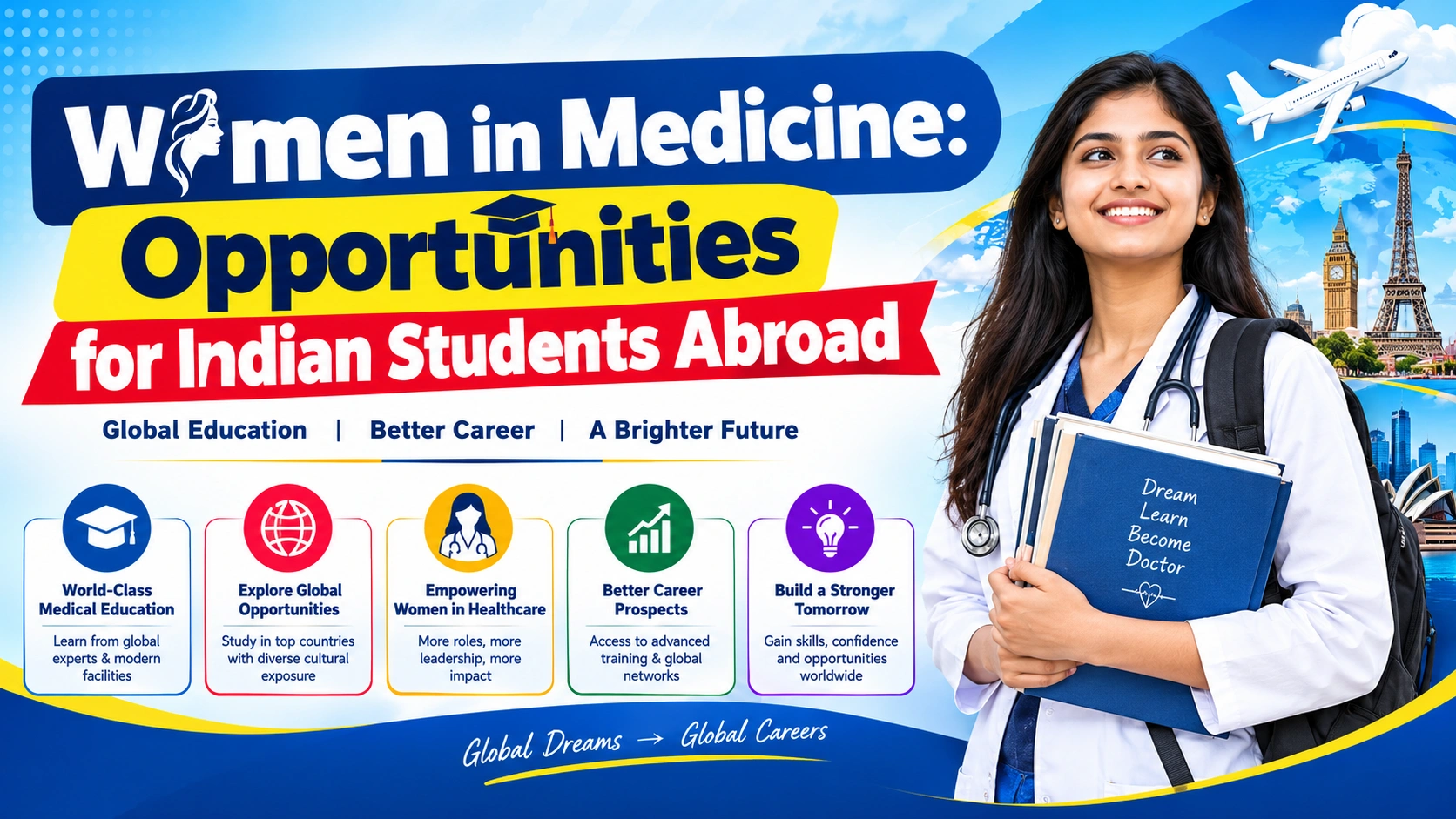
A young woman deciding to study medicine abroad usually faces two sets of questions. The first is predictable: Which country is affordable? Is the university recognised? What will happen after graduation? The second set is more personal. Is the city safe after dark? Are female students treated equally during clinical rotations? What if hostel rules are too restrictive—or not protective enough? These aren’t small concerns. Women form about 67% of the global health and social-care workforce, according to the World Health Organization. Yet senior leadership positions remain disproportionately occupied by men. That gap tells an interesting story. Women already carry much of the world’s healthcare work, but they still need better access to leadership, specialist training, research and decision-making roles.For an Indian student, studying medicine overseas can open some of those doors. It may provide international clinical exposure, independent living experience and access to multicultural research communities. Still, selecting a university only because its advertisement shows a modern campus is risky. MBBS Advisor recommends checking academic quality, safety, licensing eligibility and the complete cost before paying any admission or booking amount.
Why More Indian Women Are Considering MBBS Abroad
What pushes a student to leave home for a medical degree? Usually, it isn’t one reason. A high NEET score may still fall short of a government seat, while private medical education in India can be financially difficult for many families. An overseas option then starts looking practical.Countries such as Russia, Georgia, Kazakhstan, Kyrgyzstan and Uzbekistan offer medical programmes taught partly or fully in English. Depending on the institution and country, the tuition fee may range from roughly ?2.5 lakh to ?8 lakh per year. Private options in Georgia are generally on the higher side, while several universities in Kyrgyzstan, Kazakhstan and Uzbekistan advertise lower tuition bands. There is another factor. Freedom.Studying abroad often gives women greater responsibility for managing money, documents, travel, accommodation and daily decisions. It can feel overwhelming during the first semester, but that independence becomes professionally useful. Doctors regularly work under pressure, speak with unfamiliar people and make decisions without waiting for someone else to step in.Honestly, families don’t discuss this benefit enough.
Opportunities Available to Female Medical Students Overseas
Medicine abroad isn’t simply a route to an undergraduate degree. A good university can give female students access to research groups, student conferences, simulation laboratories, public-health projects and clinical environments that serve patients from several cultural backgrounds.
Wider Clinical and Cultural Exposure
Picture a student from Lucknow examining patients in Bishkek, Tbilisi or Almaty while learning how another country manages primary care. She notices different prescribing habits, hospital systems and patient expectations. Some practices may be better; others may not. That comparison itself is valuable. International exposure can make students more comfortable treating people from different languages and backgrounds. It also encourages adaptability, especially during community-medicine postings, paediatric rotations and emergency training. Clinical exposure, however, varies sharply between universities. A famous name doesn’t automatically mean every international student receives strong bedside training. MBBS Advisor advises students to check the teaching-hospital arrangement, patient flow, local-language training and the actual starting year of clinical rotations.
Research and Academic Participation
Research opportunities often begin with something ordinary—a professor asking for volunteers, a case presentation or a student poster competition. Female students who participate early can build experience in literature review, data collection, medical writing and conference presentation. Universities in larger cities may have better access to research hospitals and international academic events, though this isn’t guaranteed. Before admission, ask whether undergraduate students can join research projects, whether women serve as faculty mentors and whether published student work can be verified.
Specialisation Without Gender Stereotypes
Surgery is not “for men.” Paediatrics is not “for women.” Those old labels still appear in casual conversations, but they should not decide a student’s career. Women are building careers in orthopaedics, cardiology, neurosurgery, radiology, emergency medicine, oncology and hospital administration. Studying abroad may expose an Indian student to female consultants working in these fields, which can quietly change what she imagines for herself. Seeing someone do the job matters. At the same time, an overseas undergraduate degree doesn’t directly guarantee a postgraduate seat. Graduates must satisfy the licensing and postgraduate-entry rules of the country where they plan to practise.
Country-Wise Cost and Course Comparison
The numbers below are broad planning estimates, not fixed quotations. Currency movement, hostel type, university revisions and city-level living costs can change the final budget.
|
Destination |
Typical Course Length |
Approximate Tuition per Year |
Approximate Living and Hostel Cost per Year |
Common Admission Period |
|
Russia |
Around 6 years |
?3 lakh–?7 lakh |
?1.5 lakh–?3 lakh |
June–September |
|
Georgia |
Around 6 years |
?4.5 lakh–?8 lakh |
?2.5 lakh–?4 lakh |
Multiple intakes at some universities |
|
Kazakhstan |
Around 5–6 years |
?3 lakh–?5.5 lakh |
?1.5 lakh–?3 lakh |
June–September |
|
Kyrgyzstan |
Around 5–6 years |
?2.5 lakh–?5 lakh |
?1.3 lakh–?2.5 lakh |
June–October |
|
Uzbekistan |
Around 6 years |
?3 lakh–?5.5 lakh |
?1.5 lakh–?3 lakh |
June–September |
Fees look manageable. Sometimes very manageable. But not everywhere. A university may quote only tuition while excluding hostel charges, medical insurance, visa renewal, registration, laboratory expenses, local transport and food. Families should ask for a year-wise written breakup. MBBS Advisor also suggests keeping an emergency reserve equal to at least three to six months of living expenses, particularly for a student travelling alone for the first time.
Eligibility and NEET Requirement for Indian Students
The basic admission route is fairly clear. An Indian applicant normally needs Class 12 with Physics, Chemistry, Biology or Biotechnology and English, along with the required aggregate under applicable rules. She must also meet the university’s age, documentation and health requirements. For an Indian citizen planning to obtain medical registration in India after studying abroad, NEET qualification is a central requirement. Students should follow the official NEET website for notices, application dates and result information. The MBBS Advisor NEET guide can help students understand the process in simpler terms, but official notices should always receive priority. A low-cost admission offer cannot replace eligibility. If a consultant says NEET is unnecessary and the student can still return to practise in India without any issue, stop. Check the claim in writing.The qualifying score changes with each examination cycle because it is percentile-based. Don’t depend on an old cutoff screenshot circulating in a WhatsApp group. Use the current scorecard and official counselling information.
NMC Rules Matter More Than Promotional Claims
Here is where families need to slow down. A university’s admission eligibility and a graduate’s future licensing eligibility in India are not necessarily the same thing. Under the Foreign Medical Graduate Licentiate Regulations, Indian students must pay attention to requirements including the duration of study, internship, medium of instruction, subjects taught, clinical training and eligibility to practise in the country where the degree is awarded. Current guidance has referred to at least 54 months of study and a 12-month internship, subject to the complete applicable conditions. Read the latest notices from the National Medical Commission before admission. Rules can be updated, clarified or interpreted through fresh advisories, so a verbal promise from an agent isn’t enough.
MBBS Advisor recommends obtaining written answers to these questions:
- Is the entire medical programme delivered in English?
- Is the required clinical training completed in the same country?
- Does the course include all subjects required under Indian regulations?
- Can a graduate obtain registration or a licence in the country of study?
- Is the internship structured according to applicable NMC conditions?
- Have recent Indian graduates faced document or licensing problems?
A little caution now can prevent a very expensive problem six years later.
WDOMS Listing: Useful, but Frequently Misunderstood
Surprisingly, many advertisements use the phrase “WDOMS approved” as though it were a quality certificate. It isn’t. The World Directory of Medical Schools lists medical schools and provides details about their programmes. The directory itself clearly states that listing does not mean recognition, accreditation or endorsement. Students should check whether the institution and programme appear in the directory, then separately verify local accreditation, NMC compliance and licensing eligibility. One check is never enough. For students comparing MBBS abroad options, the safer approach is to review the university, programme, hospital access and regulatory position as separate items. MBBS Advisor can support this comparison, but students and parents should still read the original regulatory documents themselves.
Safety and Daily Life for Female Students
Safety is not something that can be judged from a country ranking alone. A generally safe country may still have poorly located hostels, weak transport after evening clinical duties or inadequate campus supervision.Start with the exact address. Check how far the women’s hostel is from the academic building and affiliated hospital. Ask whether transport is provided during late postings, whether hostel entry is monitored, and whether a female warden stays on site. Speak with current students—not only the student selected by an admission representative.
Useful questions include:
- Can students contact campus security at any hour?
- Are hospital rotations scheduled late at night?
- Is public transport reliable during winter?
- How are harassment complaints handled?
- Are hostel rooms and corridors covered by suitable security systems?
- Is emergency medical support available nearby?
- Are female students allowed to choose safer accommodation if the official hostel is unsuitable?
Local culture matters too. Dress expectations, public behaviour and attitudes towards international students differ. Learning basic local phrases can help with transport, shopping and patient interaction. Not glamorous. Very useful.
Challenges Women May Face Abroad
Not every part of the journey feels empowering. Homesickness can hit hard, especially during festivals or illness. Harsh winters may make daily travel difficult. Language barriers can reduce patient interaction during clinical years. Some students also face gender bias, uncomfortable behaviour or pressure to tolerate a situation because they are far from home. Financial dependence creates another concern. If fees suddenly rise or family circumstances change, a student may have limited options. This is why families should calculate the full course cost rather than only the first-year payment. There can also be restrictive hostel rules applied more strongly to women than men. Safety policies are necessary, but rules should not unfairly prevent female students from using libraries, attending academic events or completing clinical duties. Ask about this before enrolling. Not after reaching the campus.
FMGE, NExT and Returning to India
Graduating overseas is one milestone. Registration in India is another.A foreign medical graduate must comply with the screening or licentiate examination framework applicable at the time of graduation, along with internship, documentation and registration requirements. Students often hear both FMGE and NExT discussed, but implementation details and transition rules can change. Follow current NMC and examination-authority notices instead of assuming that today’s process will remain identical six years later.
Preparation should begin during the medical course. Waiting until graduation usually makes things harder. Students should revise Indian-standard textbooks, practise clinical questions and understand the pattern of the applicable licensing examination.MBBS Advisor encourages students to evaluate a university’s academic schedule realistically. If classes are weak and students depend entirely on separate coaching, the apparently cheap course may not be such a bargain.
Career Paths Beyond Traditional Clinical Practice
Medicine offers more than hospital residency. A woman with an international medical degree may later explore public health, medical research, clinical data management, healthcare consulting, medical writing, pharmaceutical medicine, health policy or hospital administration, provided she meets the qualifications required for that role.
Some graduates pursue postgraduate study in the country where they studied. Others return to India, while a smaller number apply for licensing routes in destinations such as the UK, US or Australia. Each path has its own examinations, language requirements, costs and visa rules.No single route suits everyone. A student interested in surgery may prioritise high patient flow and operating-theatre exposure. Someone considering research may prefer a university with active laboratories and publications. A future public-health professional may gain more from community postings than a shiny simulation centre.
FAQs
Is studying medicine abroad safe for Indian women?
It can be, provided the university, city, hostel and transport arrangements are properly checked. Safety varies by location and institution, so families should speak with current female students before admission.
Which country is cheapest for female medical students?
Kyrgyzstan, Kazakhstan and Uzbekistan often have lower advertised fees than Georgia, while some Russian universities also remain affordable. The cheapest university isn’t automatically the safest or academically strongest option.
Can female students practise in India after an overseas medical degree?
Yes, if they satisfy the applicable NMC eligibility, education, internship, examination and registration conditions. Admission should be taken only after checking current regulations.
Are scholarships available for women studying medicine abroad?
Some universities offer merit discounts or limited scholarships, but full medical scholarships for international students are uncommon. Always request written terms, renewal criteria and the exact amount covered.
Does a WDOMS listing guarantee NMC eligibility?
No. WDOMS listing does not itself provide accreditation, recognition or Indian licensing eligibility. Separate verification is required.
Can women choose surgical specialities after studying abroad?
Yes. Gender does not restrict specialty choice, though admission depends on licensing status, examination performance, postgraduate seats and the rules of the chosen country.
Conclusion
Women don’t need a separate version of medical education. They need fair access to safe campuses, serious clinical training, capable mentors and career opportunities that aren’t shaped by outdated assumptions. Studying abroad can provide that opportunity, but only if the decision is made with patience. Compare the full cost. Read the NMC rules. Verify the university’s status, talk to current female students and examine what happens after graduation—not just what happens on admission day. For families trying to make sense of countries, colleges and return-to-India requirements, MBBS Advisor offers practical support throughout the selection process. The aim shouldn’t be merely to secure an overseas seat. It should be to choose an education that allows a student to become a safe, confident and independent doctor. On her own terms.